

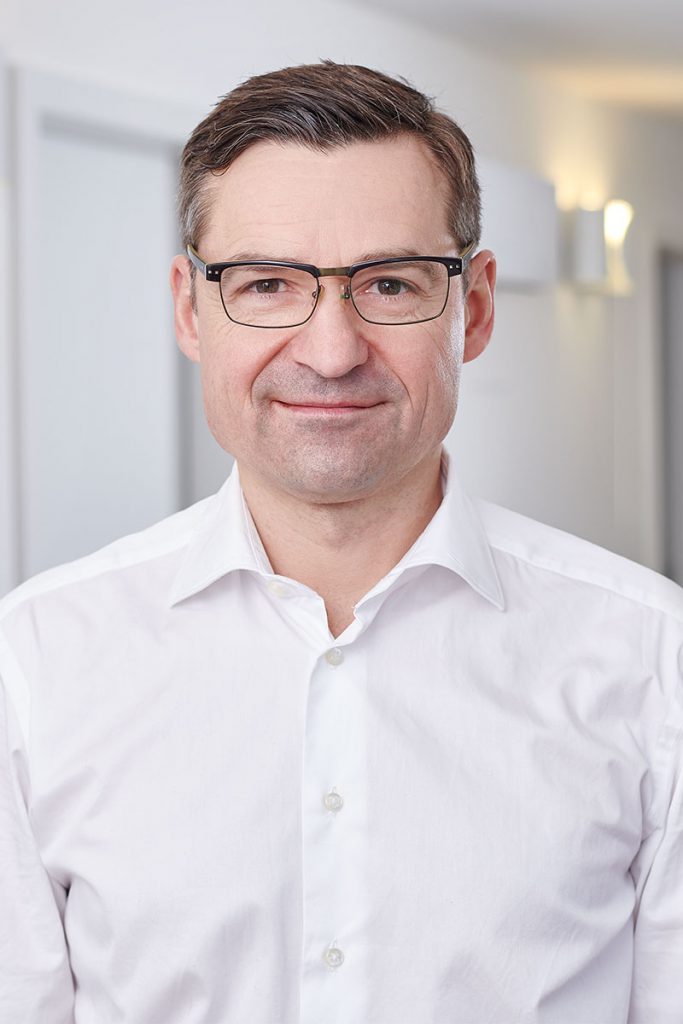
Prof. Dr. med. Thomas Paiss
Praxis Stadtmitte & Söflingen
Facharzt für Urologie
Andrologie
Medikamentöse Tumortherapie
Medizinische Genetik
Ambulante Operationen
Sexualmedizin
Studium
1985 bis 1992
Studium der Humanmedizin an der Universität Ulm
12.05.1992
Ärztliche Prüfung und Abschluss des Medizinstudiums
Dissertation
11/1988
Promotion an der Fakultät für Theoretische Medizin der Universität Ulm
Habilitation
12/2003
Habilitation für das Fachgebiet Urologie an der Medizinischen Fakultät der Universität Ulm mit dem Thema: «Die genetische Epidemiologie der Prostatakarzinomsuszeptibilität in der deutschen Population»
01.01.1994
Approbation als Arzt
1/94 bis 12/03
Verschiedene Stationen als Assistenzarzt an der Universitätsklinik Ulm in den Abteilungen Urologie, Medizinische Genetik und Chirurgie
12.6.01
Anerkennung zum Facharzt für Urologie 10/03 bis 12/03 Vertragsarzt in der Urologischen Gemeinschaftspraxis Hohmuth/Paiss, Olgastrasse 139, 89075 Ulm
03.12.03
Anerkennung für das Fach Medizinische Genetik
03/05 bis 09/09
Vertragsarzt für Urologie in eigener Praxis, Einsteinstr. 59, 89077 Ulm
25.01.07
Zusatzweiterbildung Andrologie
13.07.07
Ernennung zum außerplanmäßigen Professor an der Universität Ulm
Seit 10/09
Vertragsarzt in einer überörtlichen BAG mit Dr. Stoschek Hirschstr. 21 89073 Ulm /Gemeindeplatz 2, 89077 Ulm
6.12.2012
Erwerb des Titels Fellow of the European Commitee of sexual Medicine
Deutsche Gesellschaft für Urologie
International Consortium for Prostate Cancer Genetics
Deutsche Gesellschaft für Andrologie
European Urology, Journal of Urology, Urologe, Human Mutation, Journal of Medical Genetics, German Israel Foundation, Cancer Research UK
Veröffentlichungen Prof. Paiss (Autor bzw. Co-Autor)
1. International Consortium for Prostate Cancer Genetics. Genome-wide linkage analysis of 1,233 prostate cancer pedigrees from the International Consortium for Prostate Cancer Genetics using novel sumLINK and sumLOD analyses.
2. Identification of seven new prostate cancer susceptibility loci through a genome-wide association study.
3. Genome-wide linkage analysis of TMPRSS2-ERG fusion in familial prostate cancer.
4. The correlation between male age, sperm quality and sperm DNA fragmentation in 320 men attending a fertility center.
5. Expression changes of CAV1 and EZH2, located on 7q31 approximately q36, are rarely related to genomic alterations in primary prostate carcinoma.
6. International Consortium for Prostate Cancer Genetics. Compelling evidence for a prostate cancer gene at 22q12.3 by the International Consor
7. Association of a positive family history with histopathology and clinical course in early-onset prostate cancer.
8. Pooled genome linkage scan of aggressive prostate cancer: results from the International Consortium forProstate Cancer Genetics.
9. Prospective evaluation of prostate cancer screening in men with a family history of the disease.
10. Role of the Nijmegen breakage syndrome 1 gene in familial and sporadic prostate cancer.
11. A rare cause of recurrent macrohematuria: case report.
12. Germline mutations of the MSR1 gene in prostate cancer families from Germany.
13. Radiosensitivity detected by the micronucleus test is not generally increased in sporadic prostate cancer patients.
14. Mutation screen and association study of EZH2 as a susceptibility gene for aggressive prostate cancer.
15. Mutation screen and association study of EZH2 as a susceptibility gene for aggressive prostate cancer.
16. Association of a CAV-1 haplotype to familial aggressive prostate cancer.
17. Role of a CYP17 promoter polymorphism for familial prostate cancer risk in Germany.
18. Is the prostate cancer screening behaviour of men with familial predisposition predictable?
19. Mutation screening and association study of RNASEL as a prostate cancer susceptibility gene.
20. A genomewide linkage analysis for prostate cancer susceptibility genes in families from Germany.
21. Familial versus sporadic prostate cancer in the German population. Clinical and pathological characteristics in patients after radical prostatectomy.
22. Association between the clinical presentation and epidemiological features of familial prostate cancer in patients selected for radical prostatectomy.
23. Linkage of aggressive prostate cancer to chromosome 7q31-33 in German prostate cancer families.
24. Preventing prostate carcinoma in men with familial disposition.
25. A candidate gene approach within the susceptibility region PCaP on 1q42.2-43 excludes deleterious mutations of the PCTA-1 gene to be responsible for hereditary prostate cancer.
26. Confirmation of the prostate cancer susceptibility locus HPCX in a set of 104 German prostate cancer families.
27. Familial prostate carcinoma in Germany.
28. Some tumors of the bladder are polyclonal in origin.
29. Prostate cancer and the problem of genotype phenotype correlation.
30. Hereditary prostate cancer in germany.
31. Vitamin D receptor polymorphisms as markers in prostate cancer.
32. Genetic analysis of familial prostatic cancer: localization of a gene predisposing to prostatic cancer (PCaP) on chromosome 1q42.2-43.
33. (CAG)nCAA and GGN repeats in the human androgen receptor gene are not associated with prostate cancer in a French-German population.
34. Detailed marker chromosome analysis in cell line U-BLC1, established from transitional-cell carcinoma of the bladder.
35. The ileal neobladder: complications and functional results in 363 patients after 11 years of followup.
36. Chromosomal changes during progression of transitional cell carcinoma of the bladder and delineation of the amplified interval on chromosome arm 8q.
37. Predisposing gene for early-onset prostate cancer, localized on chromosome 1q42.2-43.
38. Does the option of the ileal neobladder stimulate patient and physician decision toward earlier cystectomy?
39. Diagnosis of intravesical ureterocele with MRI.
40. Ileal neobladder with anastomosis to the female urethra.
41. High-dose pelvic irradiation followed by ileal neobladder urinary diversion: complications and long-term results.
42. The ileal neobladder–updated experience with 306 patients.
43. The ileal neobladder in women: 9 years of experience with 18 patients
44. Extracorporeal shockwave lithotripsy in children. Complications and long-term results.